16 Jun 2026 / Essay
Noise is an org chart
Most content is not bad because the people who make it are bad. It is bad because of where it is made.
Spend a week inside any large content operation and the talent will surprise you. The writers can write. The editors can edit. The designers know what restraint looks like. And yet the output, taken in aggregate, is noise: interchangeable, forgettable, optimized to within an inch of its life and somehow saying nothing. The instinct is to blame the people. The instinct is wrong. The internet rewards what people finish, not what brands publish, and the reason most brands publish things no one finishes is not a talent problem. It is a structural one. It is in the org chart.
This is the second thing we got clear about, after we admitted the publish button is the wrong finish line. You can move the finish line to the right place, to the reader reaching the end, and still produce noise, if the way you are organized points everyone at the channel instead. So this essay is about the structure. It is about a single split that runs through almost every content team, and about why removing that split is the first thing we did and the last thing we will give up.
Two functions, two masters
Here is how the standard model is built. One function owns editorial: it decides what is good. Another function owns distribution: it decides how the work travels: which channel, which headline, which format, which time of day, which metric to chase. In a small shop these are the same two people arguing. In a large one they are separate departments with separate leaders, separate targets, and separate definitions of success. The editorial function answers to the question is this worth a reader's time. The distribution function answers to the question will this move on the channel.
Those are not the same question. Most of the time they are not even close.
The editorial function is measuring against the reader. The distribution function is measuring against the platform, and the platform does not pay for what is worth a reader's time. It pays for what is cheap to count. Impression-led content optimizes for what is cheap to count, not what is hard to earn, and the distribution function lives inside that incentive whether it wants to or not. Its dashboard is the channel's dashboard. Its bonus is tied to the channel's numbers. Its job, defined honestly, is to make the work perform against a system that rewards volume and velocity.
So now you have two functions pulling the same work toward two different definitions of good. Guess which one wins. The one with the number attached.
What the channel pays for
Watch what happens when editorial judgment is handed to distribution to "optimize." The headline gets rewritten to match what the feed surfaces. The structure gets chopped to fit the format the algorithm favors this quarter. The topic gets nudged toward the query people already search for, because that is where the traffic is. None of these moves is stupid. Each one is a competent professional doing exactly the job they were given, against exactly the metric they were handed. And the sum of all those competent moves is a piece optimized away from the reader and toward the channel.
This is the part worth sitting with. The noise is not produced by incompetence. It is produced by competence, aimed at the wrong target. Volume metrics select for content that is forgettable on purpose, not because anyone wants to forget it, but because the metric that selected it never asked whether it was memorable. It asked whether it traveled. Forgettable content travels fine. Often it travels better, because it asks less of the reader and the channel rewards what asks less.
Run that selection pressure for a few years and you do not get a team of bad writers. You get a team of good writers who have learned, correctly, that the work which survives is the work that feeds the channel. They are not failing. They are succeeding at the thing the structure measures. The structure is the problem.
Editorial and distribution are one job
So we did not separate them.
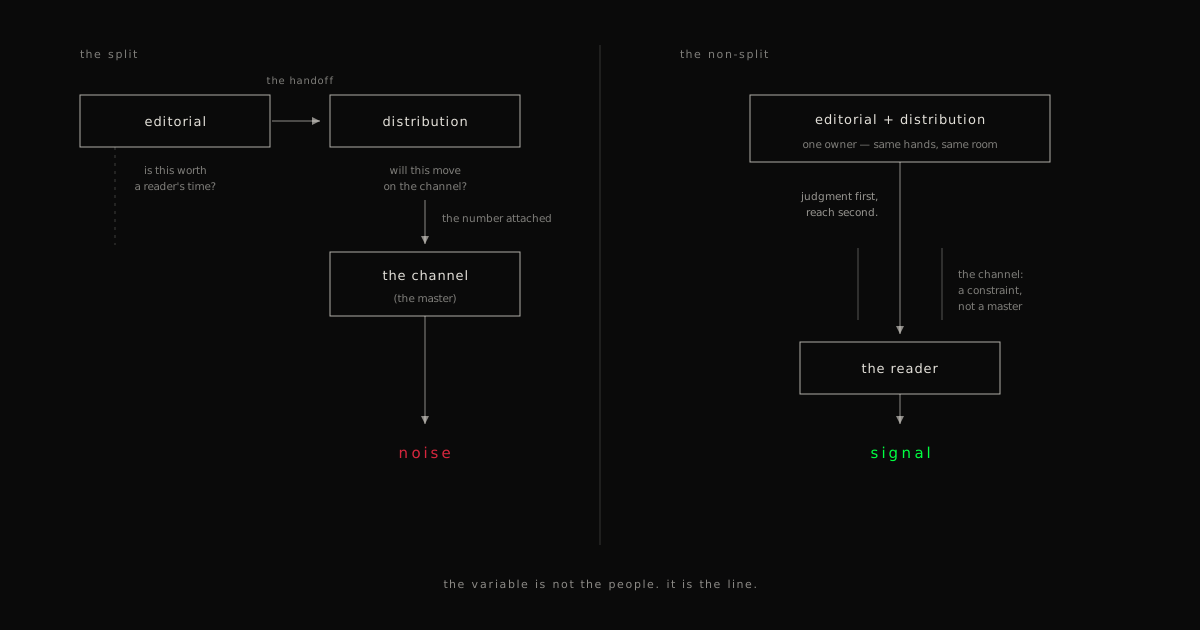
Editorial-first, distribution-aware. We do not separate the two. That sentence is the whole architecture, and it is worth saying plainly what it rules out. It rules out a growth team that owns the headline. It rules out a distribution function with a metric that can override an editorial call. It rules out the handoff: the moment where a finished piece of judgment is passed to a different department to be made to perform. There is no handoff here, because there is no other department. The people who decide what is good are the people who decide how it travels. The decisions are made by the same hands, in the same room, in that order.
This is not a productivity hack and it is not a smaller version of the same machine. It is a different machine. When one group owns both decisions, the channel stops being a master and becomes a constraint, something you are aware of, the way a writer is aware of a word count, without letting it choose the words. The distinction matters more than it sounds. A constraint shapes the work at the edges. A master chooses the work. The split hands the channel mastery; the non-split keeps it a constraint.
You can sort almost any content operation by this single line. On one side: the content farm whose topics came down from a search-traffic team, the viral-era newsroom built downstream of a share-metrics desk, the site where a "stick to sports" mandate from the business side overrode the people doing the work. On the other side: the operator who writes and ships and owns the list, the worker-owned room that left precisely to escape the split, the publication where editorial and distribution are a single role because they were never carved apart. Each of these has a real name. The search-traffic content farm is the pattern Google's spam policy files under scaled content abuse: pages generated to rank rather than to help. The "stick to sports" order is Deadspin's, in 2019, when the staff were told to drop everything that was not sports and walked out instead of complying. The room that left is Defector, the employee-owned cooperative those writers built precisely to escape the split. The first group has talent and produces noise. The second group has the same talent and produces signal. The variable is not the people. It is the line.
In that order
The order is load-bearing, so hold onto it. Editorial-first, distribution-aware. Not the reverse, and not a partnership of equals.
A partnership of equals sounds fair and produces noise, because the moment distribution gets a vote that can cancel an editorial call, the channel has a seat at the table where the work is chosen, and the channel always votes for what travels. Equality between the two functions is just the split wearing a friendlier face. What we mean by distribution-aware is narrower and stricter than that. It means the people making the editorial call already understand how the work will reach a reader, and they factor that in the way any maker factors in the medium. It does not mean a second function gets to revise the call after the fact. Distribution is downstream of judgment. It is never a peer that overrides it.
This is what it means to be editorial-led, not platform-led. The platform is real; we are not pretending the channel does not exist. We are refusing to let it choose. The sequence (judgment first, reach second, same owner for both) is the difference between a publication that uses its channels and a publication that is used by them.
Writes to the thesis, not the algorithm
There is a clean tell for which kind of operation you are looking at, and it shows up in the artifact itself.
Pagecut writes to the thesis, not to the algorithm: every piece ships in a form downstream systems can cite. That is a consequence of the non-split, not a separate initiative. When no second function rewrites the work to perform, the work keeps the shape its argument actually has: the claim stated first, the evidence attached to it, the author named, the structure legible to a person and, as it happens, to a machine reading it later. We did not bolt extractability on to chase a ranking. It falls out of doing the editorial work first and not letting anyone optimize the shape away afterward.
The split operation cannot reliably ship that artifact, because its last step is the rewrite-for-channel, and the rewrite is precisely what deforms the shape. A piece optimized to the feed is optimized to be skimmed, surfaced, and scrolled past, which is the opposite of cited. So this is not a claim about winning a ranking or topping a search result. It is a claim about form: write to the thesis and the form survives; write to the algorithm and it does not. The non-split is what lets us write to the thesis.
Why a split team can't aim for the one number that matters
We have argued elsewhere that the one number you can't buy is completion. Completion is the only reader-side metric that cannot be inflated by spend. You can pay to put a piece in front of someone; you cannot pay them to finish it. That is the number worth trusting, because it is the one money cannot reach.
Now put that number in front of a split team and watch why they cannot aim at it. Completion is a reader-side signal. The distribution function, the one with the power to choose the work, is measured on channel-side numbers, the ones money can reach. Telling a structure built around impressions and shares to optimize for finishes is like telling a compass to point at a different north. The instrument is pointed at the channel by construction. Volume is a vanity metric; finish-rate is a fitness metric, and a team organized around the vanity number cannot suddenly produce the fitness number, because the function that would have to chase it does not own the work. You do not reach a reader-side signal through a channel-side org. The structure points the team away from the finish before the work is even done.
Noise is a structure, not a verdict on the writers
So when the output reads as noise, do not start by blaming the writers. Start by drawing the line. Find the place where editorial judgment is handed to a different function to be made to perform, and you have found where the noise is manufactured. It is almost always there, and the people on both sides of the handoff are almost always doing their jobs well.
This is, in the end, a hopeful claim. Brand publishing rewards the wrong number, and most teams know it; you can feel them knowing it, in the gap between the talent in the room and the work that leaves it. If the problem were the talent, it would be hard to fix and slow to change. But it is not the talent. It is the org chart, and an org chart is a decision, not a fate. Stop separating the two functions. Let the people who decide what is good decide how it travels, in that order. The noise stops not because anyone got better, but because the structure finally points them at the reader. That is the whole move. It is also the first thing we built, before we wrote a word worth finishing.